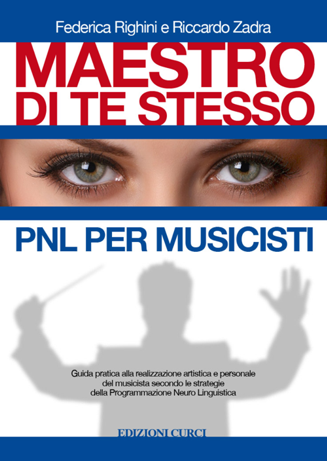
(Adapted from the article “Psicofisiologia musicale: perché?”, by Federica Righini and Riccardo Zadra.)
For too long, classical music education has remained anchored to outdated cultural models that separate mind from body, overlooking the fundamental unity between consciousness and physicality. This disconnect has led to a training gap: musicians are rarely educated in body awareness, emotional intelligence, or the mechanics of their own creative processes.
In our work, Psychophysiology of musical performance refers to an integrated approach that explores the complex relationship between body, mind, emotions and creative processes in musical practice and performance.
This perspective is the result of many years of artistic, pedagogical and research activity, and of an extensive exploration of disciplines related to personal development, body awareness and learning processes, such as Neuro-Linguistic Programming, the Feldenkrais Method, postural integration, bioenergetics and other approaches centred on perception and self-regulation.
At the core of this work lies a simple but often underestimated fact:
musical performance is never only a technical act.
It is always the expression of a global psychophysical state.
Thoughts, beliefs, emotional states, quality of attention and physical organisation directly influence:
• sound quality and tone production
• technical coordination and precision
• expressive freedom and musical communication
• stability and reliability under pressure
For this reason, improving performance means learning to work not only on musical material, but also on the internal conditions that shape the way music is learned, embodied and expressed.
From difficulties to models of excellence
Psychophysiology of musical performance does not focus exclusively on problems such as:
- performance anxiety
- excessive physical tension
- technical blocks
- memory lapses
- lack of motivation or confidence
An equally important part of the work concerns the study and development of models of artistic excellence.
By observing how highly effective performers organise their attention, perception, emotional state and physical coordination, it becomes possible to identify reproducible strategies that support artistic growth.
Musicians are encouraged to take an active role in their own development, learning how to recognise the internal processes that support or hinder their progress, and how to cultivate more effective and sustainable ways of practising, performing and relating to their artistic identity.
Attention and inner dialogue
One of the central areas of this approach concerns the management of attention.
During practice and performance, attention is continuously influenced by internal dialogue, expectations, judgments and emotional reactions.
If attention becomes fragmented or absorbed by self-critical thoughts, the quality of perception and motor control is inevitably affected.
Learning to direct attention consciously allows musicians to:
improve concentration and learning efficiency
reduce mental noise and self-sabotaging inner dialogue
stabilise performance under pressure
remain connected to sound, gesture and musical intention
Particular emphasis is placed on recognising habitual mental patterns and automatic reactions, and on developing practical strategies to return to a state of presence and perceptual clarity while playing.
The body as the first musical instrument
Another fundamental pillar of psychophysiological work is physical awareness.
Posture, breathing, movement organisation and muscle tone deeply influence:
- the quality and continuity of sound
- technical control and endurance
- freedom of gesture and articulation
- emotional expressiveness
- long-term physical health
- The body is therefore considered the performer’s first and most important instrument.
Developing refined proprioception – the capacity to feel oneself while moving and playing – allows musicians to recognise unnecessary effort, improve coordination and support technical efficiency with less strain.
Physical awareness is also essential for learning how emotional states are embodied and how tension, fear or excessive control can interfere with both technique and musical communication.
Internalisation, imagery and creative processes
Psychophysiology of musical performance pays special attention to the processes of internalisation.
Mental practice, auditory, visual and kinaesthetic imagery, and the conscious use of imagination play a decisive role in:
- strengthening memory and structural understanding
- improving rhythmic and temporal stability
- refining interpretation
- increasing confidence and creative availability
This work helps musicians move from a predominantly analytical and external approach to music towards a deeper embodied understanding of musical form, gesture and expression.
Imagination is treated not as a decorative element, but as a powerful cognitive and perceptual tool that directly influences learning, motor organisation and artistic intention.
Beliefs, motivation and artistic identity
Beliefs about talent, success, failure, effort and self-image strongly affect the way musicians study, perform and evaluate themselves.
Psychophysiology of musical performance investigates how:
- personal beliefs
- emotional habits
- values and motivations
- shape learning strategies, performance behaviour and long-term professional choices.
Musicians learn to recognise limiting internal narratives and to develop a more constructive and flexible relationship with mistakes, uncertainty and artistic growth.
Clarifying personal motivations and artistic values becomes a key element for sustaining energy, creativity and commitment over time.
The art of practising
Rather than referring to a fixed and universal “practice method”, we speak of an art of practising.
This means learning how to:
- formulate clear and meaningful practice goals
- transform mistakes into functional feedback
- manage time, attention and energy effectively
- avoid mechanical and compulsive repetition
- cultivate curiosity, engagement and pleasure in practice
Effective practice is understood as a process of continuous self-observation and self-regulation, in which technical, perceptual, emotional and motivational aspects are integrated.
In this perspective, practising becomes not only a means to improve performance, but also a powerful path of personal and artistic development.